April 28, 2026 • 10 min read
How a Pro Actually Preps a Garage Floor for Epoxy (And Why DIY Kits Fail)
Diamond grinding, moisture testing, crack repair, and dust extraction — the real prep work that separates a 20-year floor from an 18-month peel.
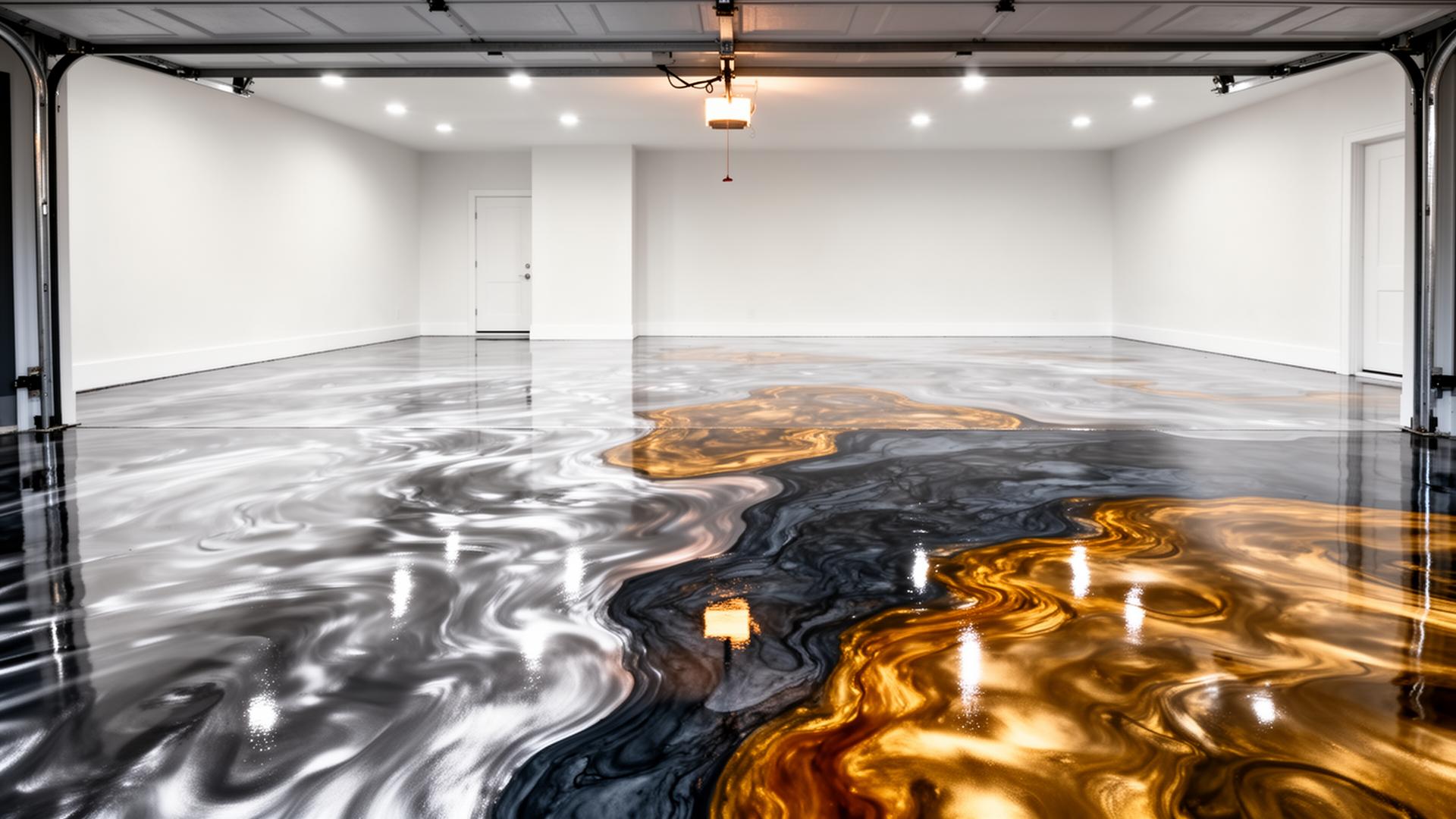
Every week, somebody calls our shop asking us to ‘touch up’ a DIY epoxy floor they installed 6–24 months ago. By the time they call, the coating is curling at the edges, peeling around the garage door, or has hot-tire pickup where their truck parks. The conversation is always uncomfortable, because there is no touch-up: when an epoxy floor fails from poor prep, the only fix is to grind the whole thing off and start over — usually for more than it would have cost to hire it out the first time.
This article exists so you know what real prep looks like, whether you DIY or hire a pro. If your contractor isn’t doing the things below, you’re buying a floor that will fail.
Step 1: Moisture Testing
Concrete is constantly moving water vapor up from the soil through the slab. In Central Alabama, where annual rainfall averages 56 inches and summer humidity sits at 75%, vapor drive is a real problem. Coatings applied over a wet slab will eventually delaminate as the moisture pushes them off the concrete from underneath.
Before any coating goes down, we run a calcium chloride test (ASTM F1869) or use an in-situ RH probe (ASTM F2170) to measure moisture vapor emission rate (MVER) and relative humidity inside the slab. Standard epoxy primers handle up to 3 lbs/MVER. Above that, we use a moisture-mitigating primer rated for 12, 18, or even 25 lbs. A contractor who doesn’t mention moisture testing is gambling with your money.
Step 2: Diamond Grinding (Not Acid Etching)
This is the single most important sentence in this article: acid etching does not properly profile concrete for modern coatings. Acid etching is the technique sold in every DIY epoxy kit at the hardware store. It removes the surface laitance but it does not open up the pores of the concrete enough to give epoxy a mechanical bond, and it leaves the surface chemically contaminated. This is the #1 reason DIY kits fail.
Professional installers use planetary diamond grinders — typically a 480- to 700-pound machine with diamond-impregnated tooling that mills the top 1/16 inch of concrete off, leaving a clean, open profile (CSP-2 to CSP-3 per ICRI 310.2R). This gives the coating both a chemical bond and a mechanical key. It is loud, dusty work, and the equipment to do it correctly costs more than most cars. There’s a reason every legitimate epoxy shop owns at least one.
Step 3: Dust Extraction
Grinding without a HEPA dust shroud is illegal under OSHA 1926.1153 (the silica rule), and any contractor doing it that way is exposing both their crew and your family to crystalline silica — a known carcinogen. A proper grind uses a continuous-flow HEPA vacuum running 300+ CFM behind the grinder, and the slab is then vacuumed three more times before any coating goes down. Even a small amount of dust left on the surface will cause a coating failure.
If you can see footprints in residual dust when the grinding is finished, your floor is not ready for coating. Walk through your garage barefoot the morning of install — if your feet come out clean, the prep was done right.
Step 4: Crack and Joint Repair
Every concrete slab in Alabama has cracks. Most of them are cosmetic, but some are active — meaning they move with temperature and humidity. Filling an active crack with a rigid material will cause the coating to telegraph that crack within a season. We use a semi-rigid polyurea joint filler (Metzger McGuire RS 88 or equivalent) that flexes with the slab and stays flush, then we re-grind the patch level with the surrounding concrete.
Control joints (the saw-cut lines in most garage floors) are a separate conversation. Some homeowners want them filled flush for a seamless look; others want them honored as cosmetic lines. Both are valid; just know that filled joints can occasionally crack at the line over time as the slab moves.
Step 5: Spall and Pit Repair
Spalls (chunks missing from the surface) and pits (small holes) get filled with a fast-cure epoxy mortar — typically the same 100% solids epoxy mixed with silica sand. We trowel it flush, let it cure 30 minutes, and re-grind. Skipping this step means every imperfection in your old slab will be visible in your new floor.
Step 6: Final Vacuum and Tack
Three passes with the HEPA vac. Then a microfiber tack cloth over every square inch. Then we walk the floor with a halogen work light at a low angle to spot any remaining dust or debris. Only then do we open the first kit of resin.
Total prep time for a 2-car garage: usually 6–8 hours, sometimes 10. The actual coating application takes 2–3 hours. If a contractor quotes you a 1-day install with no day for prep, ask exactly how they plan to grind, repair, and clean a 500 sq ft slab in three hours. The answer is: they’re not.
The Bottom Line
A great epoxy floor is 90% prep and 10% coating. Pay for the prep. Or, more accurately, hire a contractor who pays for the prep so you don’t have to think about it.
If you’d like to see what proper prep looks like in person, we’re happy to invite you to an active job site in Montgomery — most weeks we have something going. Call (334) 555-0183 to set it up.